
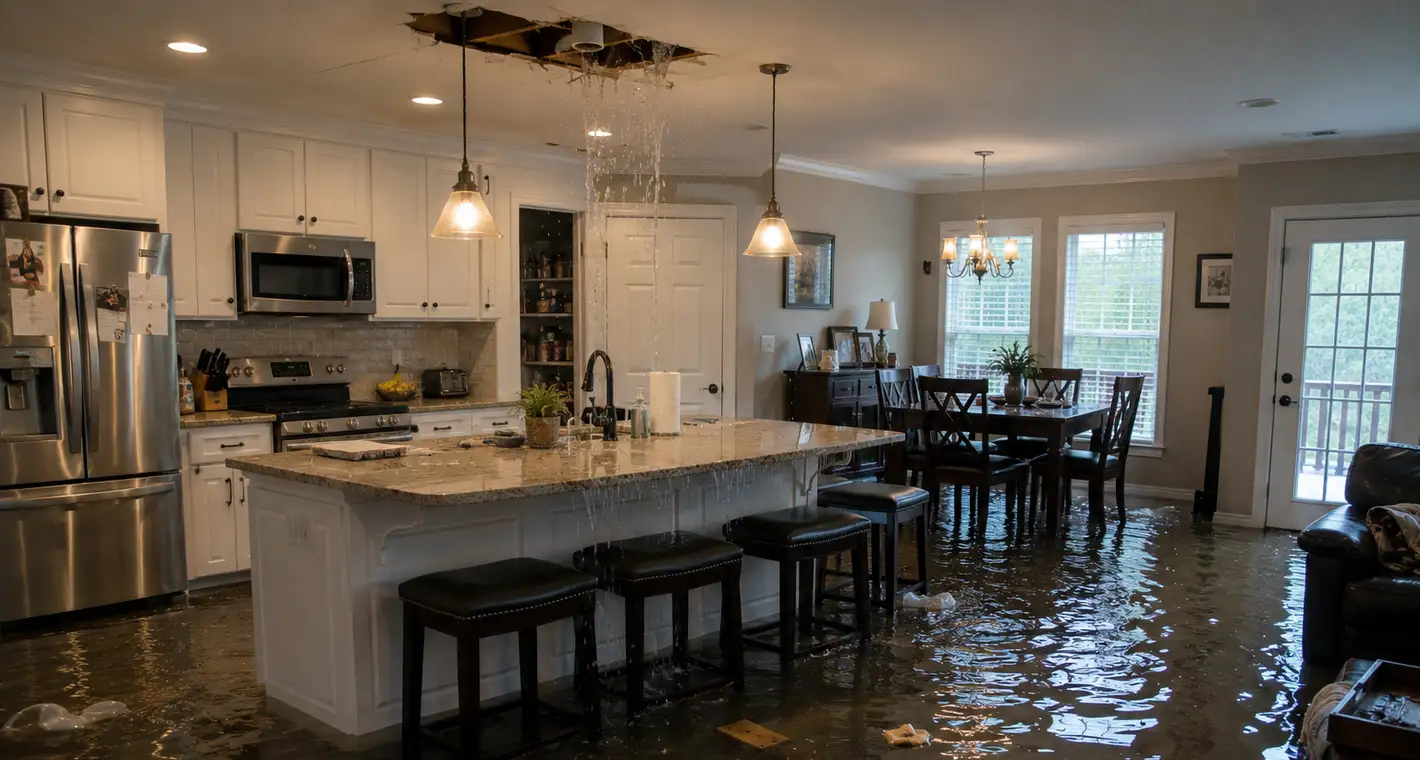
Water damage in Quartz Hill
Quartz Hill sits on the west side of the valley against the base of Portal Ridge, on ground slightly higher than the Lancaster floor and cut by several shallow washes. A semi-rural core of 1960s and 1970s custom houses on large lots, filled in by tract building through the 1990s. Slab is standard, and wells and septic systems still serve the western edge.
Before help arrives
- Shut the water off at the fixture or the main if you can reach it safely.
- Keep out of any room where water has reached outlets, cords, or the electrical panel.
- Lift furniture off wet carpet and move what you can to a dry floor.
- Photograph the damage and the failure point before anything is moved.
- Do not use a household vacuum to pick up standing water.
Common causes in Quartz Hill
Runoff coming off Portal Ridge
The ridge to the south and west sheds straight onto the community, and the washes that carry it are shallow and easy to lose track of behind a fence or under a driveway culvert. During a winter storm a culvert that has silted up puts the flow onto a lot rather than through it.
Private wells and pressure tanks
Properties on the western fringe run their own well, with the pump, pressure tank and controller housed in a garage, a shed or an outbuilding. Nothing meters those failures, so nothing warns you that water is running. A split tank fitting or a stuck pressure switch can discharge for hours, and where the equipment shares a slab with the garage the water travels under the wall into the house.
Original copper in the older core
Houses from the 1960s and 1970s along the older streets generally still hold their first copper supply system. Copper of that age develops pinhole failures, and hard valley water works on it from the inside. A pinhole in a wall or under the slab weeps rather than bursts, so it tends to be found by a rising water bill or a musty room instead of by anything dramatic.
Irrigation runs across large lots
Large parcels here carry long irrigation runs to keep landscape and orchard trees alive through the summer, often on shallow buried poly line with barbed fittings. A fitting that lets go underground is invisible: the controller keeps running that zone and the water saturates the ground beside it. Where the zone sits against the house, saturated ground at the slab edge works its way under the foundation.
Drying a Quartz Hill home
Two very different houses share the same street here, and they dry differently. A 1990s tract house is modern drywall over a slab and behaves predictably. A 1960s custom house on a large lot may hold thicker wall board of its era, layered flooring and additions built at different times, and every layer added over the years is another place water can sit unseen.
The sequence itself does not change from house to house: extraction first, then air movers and dehumidifiers working together, with moisture readings logged each day until the affected materials match the dry baseline for that building. It is described in full on the water extraction and drying page.
Services available in Quartz Hill
- Water Extraction & DryingStanding water removal and controlled structural drying under moisture readings.
- Slab Leak DamageWater surfacing through a slab-on-grade foundation, located and dried out.
- Sewage CleanupContaminated water handled with containment, removal and cleaning.
- Mold RemediationGrowth that established after water sat longer than it should have.
- Burst pipe and supply line cleanup
- Water heater and appliance leak cleanup
- Ceiling and drywall water damage
- Moisture inspection and mapping
Areas covered in Quartz Hill
Providers cover Quartz Hill and the surrounding area, including Quartz Hill Village, 50th Street West, Elizabeth Lake Road corridor, Portal Ridge foothills, Godde Hill Road and Avenue L corridor.
ZIP codes: 93536.
Frequently Asked Questions
- Will my homeowners insurance cover water damage?
- It depends on the cause rather than the damage. Policies commonly cover sudden and accidental events such as a burst supply line or a failed water heater. Damage that developed gradually from a long-standing leak, and damage from surface flooding, are usually handled differently or excluded. Photograph everything before it is moved, keep any failed part, and report the loss promptly.
- Should I turn off the electricity?
- If water has reached outlets, cords, appliances or the panel itself, treat the area as unsafe. Shut off the breaker only if you can reach the panel without standing in water and without touching anything wet. If you cannot, leave the area and have the utility or an electrician handle it.
- How do I tell an irrigation leak from a slab leak?
- Turn the irrigation controller off entirely for two or three days and watch what happens. Irrigation losses appear on a schedule and show as saturated ground outside. A slab leak keeps the meter moving with the house closed and the controller off, and shows indoors as a damp spot that returns after you dry it.
- The wash behind our lot only runs a few days a year. Is it a real risk?
- It is the days it runs that matter. Desert washes carry a large volume in a short period and drop sediment as they slow, and a culvert or fence line that has collected debris since the previous storm redirects the flow without warning. Walk the channel at the end of summer rather than during a storm, and clear what has built up where the water is meant to pass under a driveway.
- Does higher ground here mean less flooding risk than the valley floor?
- It changes the mechanism rather than removing it. The valley floor collects standing water because the water has nowhere to go. Higher ground against the ridge instead receives moving water arriving from above, which travels quickly and carries debris. Standing water sits and soaks in; moving water gets in around thresholds and garage doors and brings soil with it.
- We are on a well. What fails on that system and floods a house?
- Most often the pressure tank fitting, the pressure switch, or the line between the tank and the house. None of it is metered, so there is no bill to notice and no municipal shutoff to close. Learn where your own main shutoff and the pump breaker are before you need them, and if the equipment shares a slab with the garage, treat a wet garage floor as a house problem rather than a garage one.