
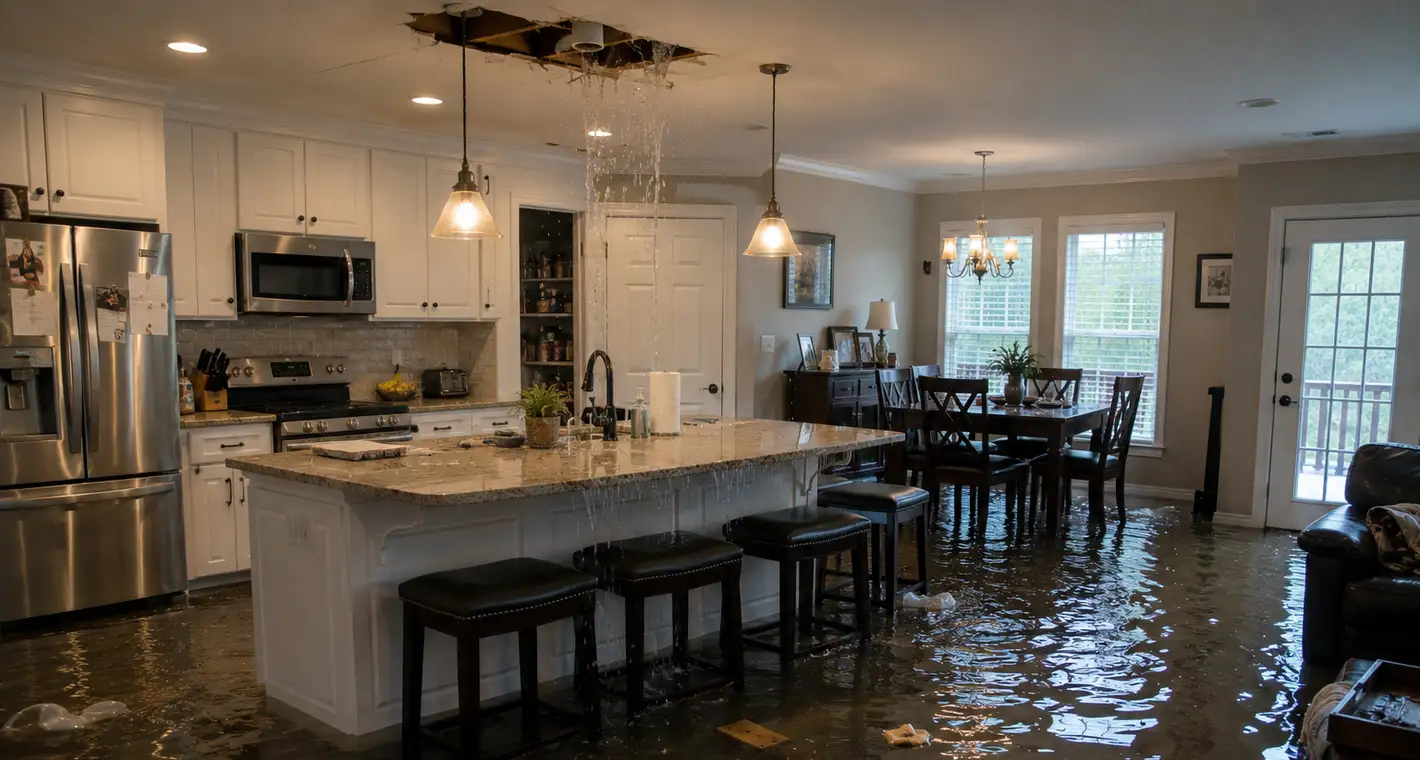
Water damage in Leona Valley
Leona Valley is a narrow valley west of Palmdale at about 3,100 feet, following the San Andreas rift zone between Portal Ridge and the Sierra Pelona, with ridges rising on both sides. Rural ranch properties on acreage, largely built from the 1960s onward with later custom houses among them. Slab and raised floors both appear, and wells, septic systems and propane are the norm.
Before help arrives
- Shut the water off at the fixture or the main if you can reach it safely.
- Keep out of any room where water has reached outlets, cords, or the electrical panel.
- Lift furniture off wet carpet and move what you can to a dry floor.
- Photograph the damage and the failure point before anything is moved.
- Do not use a household vacuum to pick up standing water.
Common causes in Leona Valley
A narrow valley collecting from two ridges
The floor here is a trough with high ground on both sides, and everything falling on either ridge crosses it on the way out. The flow concentrates into a handful of channels and roadside ditches that are dry all summer and then carry the runoff of both slopes at once.
Longer, harder freezes at elevation
At three thousand one hundred feet with cold air pooling in the valley bottom, freezing nights here are more frequent and last longer than on the floor at Lancaster. Well houses, pressure tanks, exposed runs out to barns and outbuildings, and plumbing in an unheated crawl space are all vulnerable. A split usually appears when the thaw restores pressure, and on a large property that can be a long way from anyone who would hear it.
Well and pressure systems on acreage
Every property runs its own supply, and the equipment lives in a well house or a barn rather than beside the kitchen. Nothing meters the loss and nothing alarms. A failed pressure tank, a split fitting or a stuck switch can discharge for hours, and on sloping ground the water travels downhill to whichever building sits below rather than staying where it started.
Leach fields on sloping ground
Septic systems here sit in ground that already drains across the slope, and a wet winter raises the water in the soil around a field faster than the field can move it. When a field stops accepting, waste backs up to the drain closest to the floor inside the house. On a sloped lot it can also surface outdoors downhill of the field, which is the sign that the ground is the problem rather than the tank.
Drying a Leona Valley home
Two things stretch a job here. Elevation means a house may be unoccupied or lightly used through the coldest weeks, so a break has run longer before anyone finds it and more material has passed the point where drying in place is appropriate. And where a raised floor is present, the crawl space holds water under the room while the subfloor keeps absorbing it from below.
The sequence itself does not change from house to house: extraction first, then air movers and dehumidifiers working together, with moisture readings logged each day until the affected materials match the dry baseline for that building. It is described in full on the water extraction and drying page.
Services available in Leona Valley
- Water Extraction & DryingStanding water removal and controlled structural drying under moisture readings.
- Slab Leak DamageWater surfacing through a slab-on-grade foundation, located and dried out.
- Sewage CleanupContaminated water handled with containment, removal and cleaning.
- Mold RemediationGrowth that established after water sat longer than it should have.
- Burst pipe and supply line cleanup
- Water heater and appliance leak cleanup
- Ceiling and drywall water damage
- Moisture inspection and mapping
Areas covered in Leona Valley
Providers cover Leona Valley and the surrounding area, including Elizabeth Lake Road, Leona Avenue, Godde Hill Road, 90th Street West, Munz Ranch Road and Three Points.
ZIP codes: 93551.
Frequently Asked Questions
- Will my homeowners insurance cover water damage?
- It depends on the cause rather than the damage. Policies commonly cover sudden and accidental events such as a burst supply line or a failed water heater. Damage that developed gradually from a long-standing leak, and damage from surface flooding, are usually handled differently or excluded. Photograph everything before it is moved, keep any failed part, and report the loss promptly.
- Should I turn off the electricity?
- If water has reached outlets, cords, appliances or the panel itself, treat the area as unsafe. Shut off the breaker only if you can reach the panel without standing in water and without touching anything wet. If you cannot, leave the area and have the utility or an electrician handle it.
- The roadside ditch runs past our gate every winter. Should that concern us?
- It is worth understanding where it goes rather than only that it runs. Those channels carry water from both ridges and they change with each storm as sediment and brush move around. The real question is what happens at the culvert or crossing below your property: if that is restricted, water backs up and finds a new route, and the new route is decided by the ground rather than by your fence line.
- Our well house is a hundred yards from the house. Does that keep the risk away?
- It moves the risk rather than removing it. A failure at the well house floods that building and then follows the ground downhill, so what it reaches depends on the grade rather than the distance. It also delays discovery, because nobody passes the equipment daily. Knowing where the pump breaker is, and having a way to shut the supply at the house as well as at the well, is worth arranging before it matters.
- Does being on the fault line matter for water damage?
- Not in the way people expect. What the rift zone does here is shape the landscape: it created the narrow valley, the two ridges and the drainage pattern that concentrates runoff into a few channels. That geography is what decides where water goes.
- We are away for part of the winter. What reduces the risk while the house is empty?
- Shutting the water off at the house main when you leave removes most of it, since a line that splits cannot keep running. Beyond that: drain the exposed runs and the outside bibs, leave the heat on low rather than off entirely, and have someone walk the property after a hard freeze.