
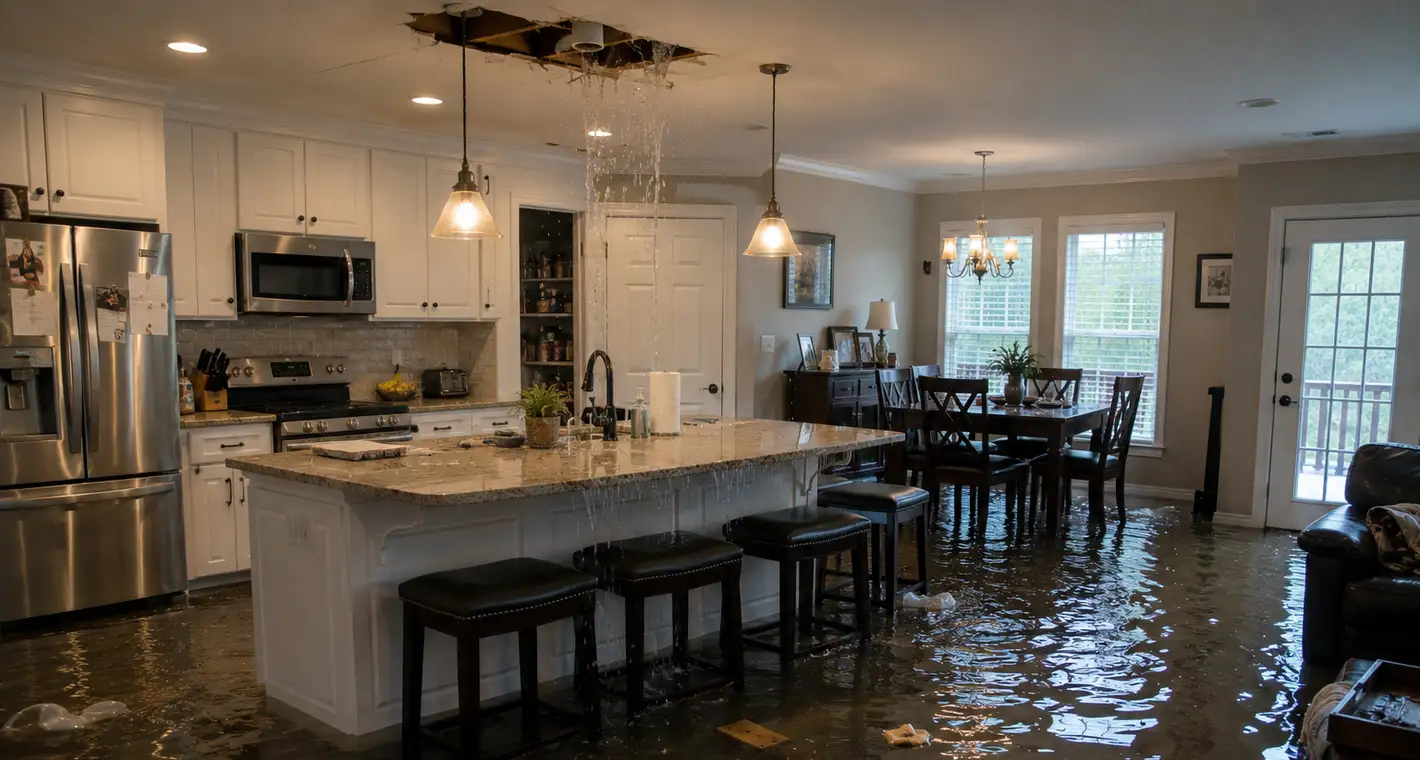
Water damage in Lancaster
Lancaster sits on the floor of the Antelope Valley at about 2,350 feet, in a closed basin that drains north toward Rosamond Dry Lake rather than to the sea. Amargosa Creek crosses the western side of the city. Construction runs from 1950s and 1960s ranch houses around the Boulevard out to large tract subdivisions from the late 1980s and the 2000s. Slab-on-grade throughout, with the water heater standing in an attached garage.
Before help arrives
- Shut the water off at the fixture or the main if you can reach it safely.
- Keep out of any room where water has reached outlets, cords, or the electrical panel.
- Lift furniture off wet carpet and move what you can to a dry floor.
- Photograph the damage and the failure point before anything is moved.
- Do not use a household vacuum to pick up standing water.
Common causes in Lancaster
Nights below freezing on the valley floor
The high desert gives up its heat after sundown, and Lancaster records dozens of nights below freezing between November and March. Plumbing that never sees a hard freeze elsewhere in Southern California sees one here: hose bibs left connected to a garden hose, irrigation backflow assemblies standing above grade, and supply runs through an unheated attached garage.
Evaporative coolers standing on the roof
Summer humidity in the valley sits low enough that evaporative coolers work well, and a great many Lancaster houses run one on the roof. Each unit has a small supply line, a float valve and a pan sitting directly over the ceiling. A float that sticks or a line that splits puts water into attic insulation and through the drywall below, and because the unit is out of sight it can run that way for days.
Water heaters on the garage slab
With no basement, the tank sits in the garage or in a closet off it, on the same pour as the living space. Valley water carries enough mineral content to scale a tank ahead of its rated life, and when the shell finally lets go the water does not stay in the garage. It runs under the wall into the hallway, then into carpet padding and the base of the drywall on the other side.
Sheet flow across a flat basin floor
Winter storms arrive over several days and the valley floor has very little natural fall to move water off. Streets carry it instead, and where a driveway slopes back toward a house or a yard has settled toward a wall, several inches stand against the foundation. Slab construction sits close to grade here, so standing water reaches the sill plate and the base of the wall directly rather than a foundation wall.
Drying a Lancaster home
Lancaster losses are almost all slab losses, which means the wet area is wider and lower than it looks: water runs under carpet padding and beneath floating plank until it reaches a wall base. Dry outdoor air does nothing for a closed wall cavity, and the caliche layer under the slab holds water rather than letting it drain away.
The sequence itself does not change from house to house: extraction first, then air movers and dehumidifiers working together, with moisture readings logged each day until the affected materials match the dry baseline for that building. It is described in full on the water extraction and drying page.
Services available in Lancaster
- Water Extraction & DryingStanding water removal and controlled structural drying under moisture readings.
- Slab Leak DamageWater surfacing through a slab-on-grade foundation, located and dried out.
- Sewage CleanupContaminated water handled with containment, removal and cleaning.
- Mold RemediationGrowth that established after water sat longer than it should have.
- Burst pipe and supply line cleanup
- Water heater and appliance leak cleanup
- Ceiling and drywall water damage
- Moisture inspection and mapping
Areas covered in Lancaster
Providers cover Lancaster and the surrounding area, including The Boulevard, West Lancaster, East Lancaster, Antelope Acres, Del Sur, Fox Field and Challenger Way corridor.
ZIP codes: 93534, 93535, 93536.
Frequently Asked Questions
- Will my homeowners insurance cover water damage?
- It depends on the cause rather than the damage. Policies commonly cover sudden and accidental events such as a burst supply line or a failed water heater. Damage that developed gradually from a long-standing leak, and damage from surface flooding, are usually handled differently or excluded. Photograph everything before it is moved, keep any failed part, and report the loss promptly.
- Should I turn off the electricity?
- If water has reached outlets, cords, appliances or the panel itself, treat the area as unsafe. Shut off the breaker only if you can reach the panel without standing in water and without touching anything wet. If you cannot, leave the area and have the utility or an electrician handle it.
- Water appeared on the floor with nothing leaking above it. What is that?
- That pattern usually points to a supply line under the slab. Water has no open path down there, so it saturates the fill under the concrete first and then surfaces through a crack, a joint or the slab edge, often as a damp patch that keeps returning after you dry it. If the spot feels warm underfoot, a hot line is involved.
- The evaporative cooler stained a ceiling. Is drying the drywall enough?
- Usually not on its own, because the drywall is the last thing the water reached. Above it is attic insulation that absorbed the water and gives it back slowly, and the framing it sat against. Saturated blown insulation is normally removed rather than dried, since it stops working once wet and holds water against the framing.
- The house is from the 1960s near the Boulevard. Does age change the response?
- It changes what is behind the surface. Houses of that period around the older core often still carry their original copper, and copper of that age develops pinhole failures that weep for a long time before anything shows. Those walls also hold layers added during later remodels, and flooring laid over flooring traps water between the two.
- Does the dry air in Lancaster mean the house will dry out on its own?
- Not inside the assembly. Outdoor humidity in the valley is low for most of the year, and that helps a great deal once a cavity has been opened and air is moving through it. It does nothing for water sitting between a floating floor and the slab, inside a wall below the drywall line, or in soaked carpet padding, because none of those exchange air with the room.