
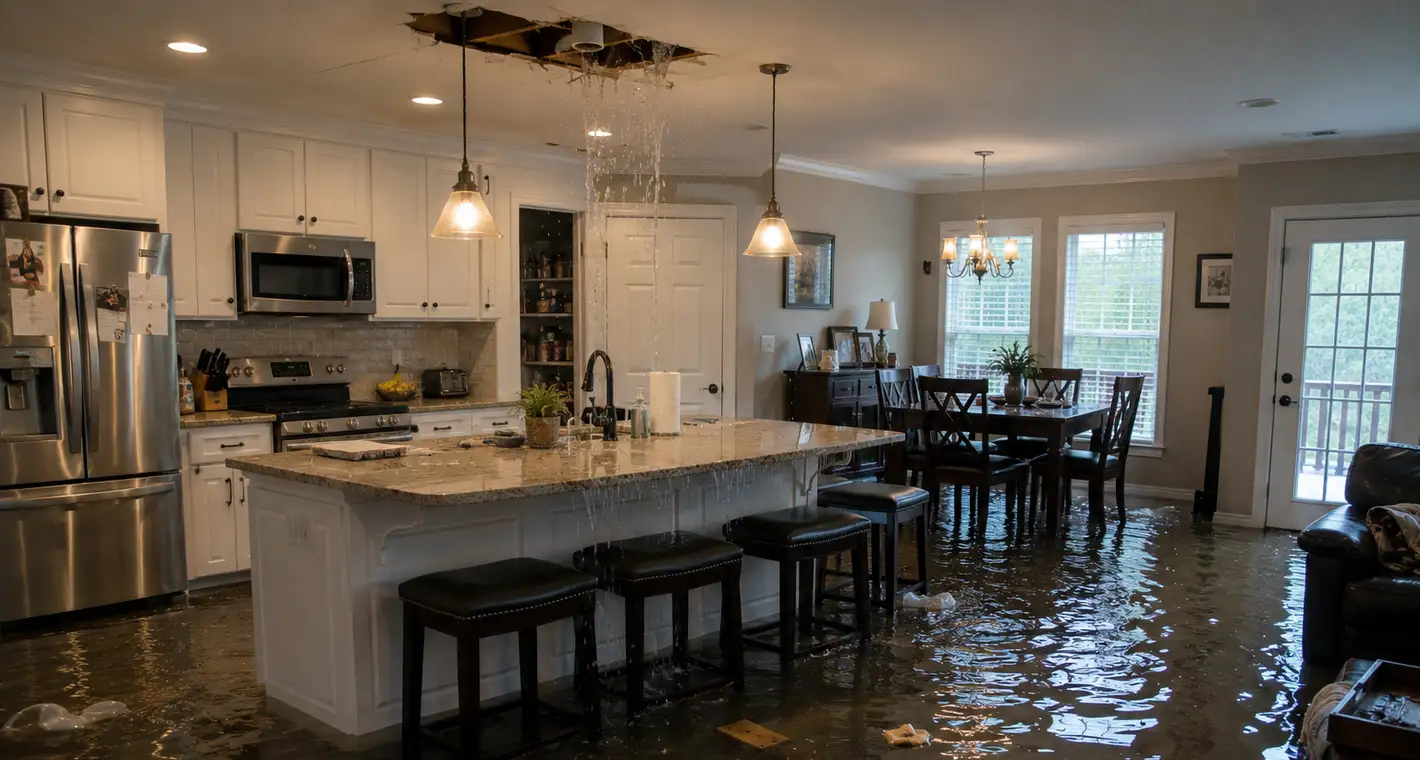
Water damage in Littlerock
Littlerock sits at the southeast edge of the valley where Little Rock Creek leaves the San Gabriels, below Littlerock Dam, on ground first laid out for fruit orchards. A mix of orchard-era houses from the 1930s to the 1950s, some of them on raised floors, and later slab construction along the highway and the numbered streets. Septic systems are common and lots are large.
Before help arrives
- Shut the water off at the fixture or the main if you can reach it safely.
- Keep out of any room where water has reached outlets, cords, or the electrical panel.
- Lift furniture off wet carpet and move what you can to a dry floor.
- Photograph the damage and the failure point before anything is moved.
- Do not use a household vacuum to pick up standing water.
Common causes in Littlerock
Debris flow off the Bobcat Fire burn scar
The Bobcat Fire burned roughly 115,000 acres of the San Gabriels above here in September 2020, and burned ground sheds water instead of absorbing it for years afterward. Rain that a healthy slope would have taken in runs off carrying ash, soil and rock, and it arrives in the channels below as mud rather than water.
Little Rock Creek and its wash
The creek is dry most of the year and then carries the runoff of a whole mountain front for a few days. Below the dam the channel braids and shifts across its wash, so the bank that held last winter is not necessarily the bank that holds this one.
Original plumbing in orchard-era houses
The oldest houses in Littlerock were plumbed in galvanised steel, and where it survives it corrodes from the inside until a threaded joint gives way. Copper added during later remodels is now old enough to develop pinholes of its own. In a house that has been added to several times, supply lines of three different eras can run in the same wall, and a failure in one is no guide to the condition of the rest.
Septic on ground that stops accepting water
Leach fields here sit in coarse wash material that drains well in a dry year and stops working when the water under the wash comes up after a wet winter. A field that has never given trouble can back up in the one season the ground around it is already saturated. The backup surfaces at the drain closest to the floor, usually a tub, and it is contaminated water rather than a plumbing nuisance.
Drying a Littlerock home
Two very different buildings share these streets. An orchard-era house on a raised floor holds water in the crawl space and in wall board of its era that gives it back slowly. A newer slab house spreads it sideways under the flooring instead. Where a loss involved mud or septic water, material comes out and surfaces are cleaned before any drying equipment is set.
The sequence itself does not change from house to house: extraction first, then air movers and dehumidifiers working together, with moisture readings logged each day until the affected materials match the dry baseline for that building. It is described in full on the water extraction and drying page.
Services available in Littlerock
- Water Extraction & DryingStanding water removal and controlled structural drying under moisture readings.
- Slab Leak DamageWater surfacing through a slab-on-grade foundation, located and dried out.
- Sewage CleanupContaminated water handled with containment, removal and cleaning.
- Mold RemediationGrowth that established after water sat longer than it should have.
- Burst pipe and supply line cleanup
- Water heater and appliance leak cleanup
- Ceiling and drywall water damage
- Moisture inspection and mapping
Areas covered in Littlerock
Providers cover Littlerock and the surrounding area, including Pearblossom Highway corridor, Little Rock Creek wash, Cheseboro Road, 82nd Street East, Sun Village and Avenue T corridor.
ZIP codes: 93543.
Frequently Asked Questions
- Will my homeowners insurance cover water damage?
- It depends on the cause rather than the damage. Policies commonly cover sudden and accidental events such as a burst supply line or a failed water heater. Damage that developed gradually from a long-standing leak, and damage from surface flooding, are usually handled differently or excluded. Photograph everything before it is moved, keep any failed part, and report the loss promptly.
- Should I turn off the electricity?
- If water has reached outlets, cords, appliances or the panel itself, treat the area as unsafe. Shut off the breaker only if you can reach the panel without standing in water and without touching anything wet. If you cannot, leave the area and have the utility or an electrician handle it.
- We were flooded with muddy water. Is that treated as a normal water loss?
- It is handled differently. Mud carries soil, ash and whatever the channel picked up, and it does not evaporate or extract the way clean water does. It is removed physically first, surfaces are cleaned, and only then is the structure dried. Carpet, padding and the bottom band of drywall it reached are normally removed rather than cleaned, because that material cannot be cleaned all the way through.
- Our house is from the 1940s. What is likely to be behind the walls?
- Very often a mixture. Original galvanised supply lines where they were never replaced, copper added during a later remodel, and wall assemblies that may be lath and plaster rather than modern drywall. Plaster holds a great deal of water and gives it back slowly, which lengthens drying, and layered flooring from successive remodels traps water between the layers where nothing shows on the surface.
- How much warning is there when the wash runs?
- Not much, and that is worth knowing in advance rather than during a storm. Desert channels go from dry to full within an hour of rain falling on the mountains above, and it does not have to be raining at your house for the wash to run. If your property sits near the channel, the useful preparation happens in dry weather: know where the water shutoff is and keep the ground drainage around the house clear.
- The burn scar is miles away. Does it really affect houses down here?
- It affects what arrives in the channels below it. Burned slopes shed a far larger share of the rain that falls on them and carry loose soil along with it, and that continues for several seasons while vegetation returns. The result at the bottom of the range is a heavier, dirtier flow in the same washes that were manageable before.